
 PL





1. Comparison of Japanese and Spanish Front Drive Shafts
Vitara I models with 1.6 8V/16V, 1.9 D and 2.0 HDi engines (1994–2003) are usually Spanish versions (Suzuki-Santana Vitara I). When installing a suspension lift, the Spanish "weak" front drive shafts should be replaced with, for example, Japanese ones. Spanish "weak" drive shafts have an insufficient operating angle and are not suitable for use with a raised suspension of 2", 3" or 4".
The easiest way to identify the Vitara version is by checking the VIN. If it starts with the letter "V", the vehicle was manufactured in Spain. However, you should always verify this by carefully checking the type of drive shafts currently installed.
The left front drive shaft is bolted to the differential with 3 bolts. Any Japanese drive shaft from a Suzuki Vitara 1.6 (1988–1995) will fit.
Japanese and Spanish right drive shafts are available in two versions: with either 22 or 26 splines on the differential side.
To select the correct Japanese drive shaft, remove the old Spanish drive shaft from the differential and check whether it has 22 or 26 splines.
Japanese right drive shafts with 22 splines on the differential side are readily available, as they were fitted to all Suzuki Vitara 1.6 models from 1988–1995.
Japanese right drive shafts with 26 splines on the differential side are very rare. They were fitted only to some Vitara I 1.6 / X-90 models (1995–1998).
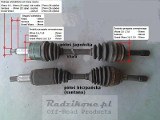
Comparison photos below.

2. How to Obtain a Japanese Right Drive Shaft with 26 Splines for a Suzuki Santana Vitara I
Method 1:
Required parts:
-
An original used Japanese right drive shaft from a Vitara I 1.6 (narrow frame), with the following specifications:
- outer CV joint Ø 76 mm, 26 splines on the wheel side
- inner CV joint Ø 76 mm, 22 splines on the differential side
- Center shaft Ø 23/24 mm, 22 splines
- overall compressed drive shaft length Lmin = 595 mm
-
An original used "thin" right drive shaft from a Vitara I 2.0 (wide frame) or GV I
with an inner CV joint extension,
with the following specifications:
- outer CV joint Ø 76 mm, 26 splines on the wheel side
- inner CV joint Ø 76 mm, 26 splines on the differential side
- Center shaft Ø 24 mm, 29 splines
- overall compressed drive shaft length Lmin = 611 mm / 607 mm on GVI
Remove the inner CV joint housing (22-spline version) from the Japanese Vitara 1.6 drive shaft, disassemble it and retain only the part that fits onto the shaft (without the balls and cage).
Then install the 26-spline inner CV joint housing from the Vitara 2.0 drive shaft, together with its balls and cage.
Note! This procedure cannot be performed using new aftermarket replacement parts. It can only be done with original OE Suzuki NTN CV joints.

Method 2:
Required parts:
- A right inner CV joint from a Spanish "weak" drive shaft with 26 splines.
- A complete Japanese right drive shaft with 22 splines on the differential side, from a Suzuki Vitara 1.6 (both CV joints must have an outer diameter of 76 mm).
Cut off a section of the inner CV joint from the Spanish "weak" drive shaft (from a Santana), including the 26-spline section.
Cut off the housing from the inner CV joint of the "Japanese 22-spline" drive shaft.


Next, carefully weld the Japanese CV joint housing to the 26-spline section.

Transfer the internal CV joint components from the Japanese version and assemble everything onto the Japanese drive shaft.
Method 3:
Required parts:
-
An original used "XL7 facelift" right drive shaft from a Grand Vitara XL7 2.7 V6 / 2.0 HDi (2004–2005), with the following specifications:
- outer CV joint Ø 81 mm, 26 splines on the wheel side
- inner CV joint Ø 79 mm, 26 splines on the differential side
- Center shaft Ø 28 mm, 32 splines
- overall compressed drive shaft length Lmin = 588 mm + R-SVGV-PPPW
- Additionally, a right inner CV joint extension.
Method 4:
Required parts:
- Extended front VB A-arms.
- Reinforced, longer drive shafts, e.g. SORP4x4 or modified "thick" drive shafts (right drive shaft with an extension = Lmin 611 mm and left drive shaft using the Center shaft from the right drive shaft = Lmin 508 mm).
3. All Types of Front Drive Shafts Used in the Vitara I
Narrow frame - RIGHT drive shafts:
| Drive shaft type | Outer CV joint (wheel side) |
Inner CV joint (differential side) |
Center shaft | Overall compressed length (Lmin) |
|---|---|---|---|---|
| Japanese - 22 splines Vitara I 1.6 (1988–1995) |
Ø 76 mm 26 splines |
Ø 76 mm 22 splines |
Ø 23/24 mm 22 splines |
595 mm |
| Japanese - 26 splines Vitara I 1.6 / X-90 (1995–1998) |
Ø 76 mm 26 splines |
Ø 76 mm 26 splines |
Ø 23/24 mm 22 splines |
595 mm |
| Spanish "weak" - 22 splines Santana Vitara I 1.6 / 1.9 D (1993–1997) |
Ø 82 mm 26 splines |
Ø 72 mm 22 splines |
Ø 23/24 mm 22 splines |
~591 mm |
| Spanish "weak" - 26 splines Santana Vitara I 1.6 / 1.9 D / 2.0 HDi (1994–2003) |
Ø 82 mm 26 splines |
Ø 72 mm 26 splines |
Ø 23/24 mm 22 splines |
~591 mm |
| Spanish "strong" Santana Vitara I 1.6 / 2.0 HDi (2003–2006) |
Ø 90 mm 26 splines |
Ø ~100 mm 26 splines |
Ø 27 mm 32 splines |
~591 mm (601 mm) |
Drive shafts with a right inner CV joint featuring 22 splines are a weak point in the drivetrain, just like the aluminium front differential housing.
Spanish "weak" drive shafts have an insufficient CV joint operating angle and are not suitable for use with a raised suspension.
Spanish "strong" drive shafts extend during suspension travel. Therefore, installing a 3" or 4" Lift requires extended front VB A-arms.
Narrow frame - LEFT drive shafts:
| Drive shaft type | Outer CV joint (wheel side) |
Inner CV joint (differential side) |
Center shaft | Overall compressed length (Lmin) |
|---|---|---|---|---|
| Japanese - 22 / 26 splines Vitara I 1.6 / X-90 (1989–1998) |
Ø 76 mm 26 splines |
Ø 76 mm 3 bolts |
Ø 23/24 mm 22 splines |
493 mm |
| Spanish "weak" Santana Vitara I 1.6 / 1.9 D / 2.0 HDi (1993–2003) |
Ø 82 mm 26 splines |
Ø 72 mm 3 bolts |
Ø 23/24 mm 22 splines |
489 mm |
| Spanish "strong" - 6 bolts Santana Vitara I 1.6 / 2.0 HDi (2003–2006) |
Ø 90 mm 26 splines |
Ø ~100 mm 6 bolts |
Ø 27 mm 32 splines |
488 mm (498 mm) |
Spanish "weak" drive shafts have an insufficient CV joint operating angle and are not suitable for use with a raised suspension.
Spanish "strong" drive shafts extend during suspension travel. Therefore, installing a 3" or 4" Lift
requires extended front VB A-arms.
WIDE frame - RIGHT drive shafts:
| Drive shaft type | Outer CV joint (wheel side) |
Inner CV joint (differential side) |
Center shaft | Overall compressed length (Lmin) |
|---|---|---|---|---|
| Thin Vitara I 2.0 16V / 2.0 V6 (1996–1998) |
Ø 76 mm 26 splines |
Ø 76 mm 26 splines |
Ø 24 mm 29 splines |
611 mm |
| Thick Vitara I 2.0 TD RF (1996–1998) |
Ø 80 mm 26 splines |
Ø 79 mm 26 splines |
Ø 25 mm 30 splines |
613 mm |
The right inner CV joint from the Vitara I 2.0 TD RF has a longer splined section that extends into the front differential. If used in a differential with a four-pinion carrier or a differential locker, the splined section must be shortened to prevent interference with the spider gears.
Wide-frame Vitaras can use the right "thin" and "thick" drive shafts from the GVI, provided that an extension is fitted. Available here.
WIDE frame - LEFT drive shafts:
| Drive shaft type | Outer CV joint (wheel side) |
Inner CV joint (differential side) |
Center shaft | Overall compressed length (Lmin) |
|---|---|---|---|---|
| Thin Vitara I 2.0 16V / 2.0 V6 (1996–1998) |
Ø 76 mm 26 splines |
Ø 76 mm 3 bolts |
Ø 24 mm 29 splines |
532 mm |
| Thick Vitara I 2.0 TD RF (1996–1998) |
Ø 80 mm 26 splines |
Ø 79 mm 3 bolts |
Ø 25 mm 30 splines |
532 mm |
Wide-frame Vitaras can use the left "thin", "thick" and "XL7 facelift" drive shafts from the GVI / XL7. This is because the Grand Vitara I / XL7 (1998–2005) uses left drive shafts with the same overall length and the same number of splines on the wheel side.
Radzikone Guides
 |
Wide and Narrow Frame Diagrams Suzuki Vitara I / Sidekick |
 |
How to measure a shock absorber |
 |
Zdradzamy przeróbki i patenty w aucie do rajdów |
 |
Quick front spring replacement with Radzikone A-arms |
 |
Suzuki Vitara I mods Suzuki Vitara I |
 |
3x Grand Vitara - 3d, 5d, XL7 - which one to choose? What engine? What tires? |
 |
Radzikone recovery tracks |
 |
Front knuckles Suzuki Vitara I / Grand Vitara I |
 |
Tie rods Suzuki Grand Vitara I |
 |
Wheel alignment setting Suzuki Vitara I / Grand Vitara I |
 |
Tie rods ends and tie rods Suzuki Vitara I |
 |
Front steel differential Suzuki Vitara I / Grand Vitara I |
 |
Axle ratios Suzuki Vitara I / Grand Vitara I |
 |
Satellite-Gear Carrier / Diff Case Types Vitara / Grand Vitara I / Samurai |
 |
Vitara & GVI - self-made 4-spider gear carrier |
 |
Front driveshafts Suzuki Vitara I |
 |
Front driveshafts Grand Vitara I / XL7 |
 |
How and how much cut the arches to fit too big tires? |
 |
Budget overland setup |
Other
 |
The body “floats” on the frame |
 |
Lift 4" PLUS, wzmacniane półosie itp. w Vitarze 2.0 Adama |
 |
Wyprawowa XL7 z Liftem 3" okiem widza w Terenwizji |
 |
Dawid z firmy Deler wybiera i montuje Lift do Grand Vitary I |
 |
"Terenwizja" guide Suzuki Vitara I |
 |
Front locking hub rebuild |
 |
How to check wheel offset |
 |
Rally safety tips |
 |
Radzik prezentuje dwie Vitary w Terenwizji |
Installation instructions
 |
Installing the Radzikone 4" Lift Kit for Grand Vitara I |
 |
3" and 4" Radzikone lift kit assembling Suzuki Vitara I |
 |
Setting the wheel alignment with Radzikone suspension lift kit Suzuki Vitara I / Grand Vitara I |